Lifting the evacuation - who do you tell and how?

Once you’ve issued an alert to evacuate an area, how to do inform that same population that they can return?
Consider this scenario: you identify a small boundary surrounding the population that needs to leave due to wildfire, chemical spill, gas leak, or some other event, and you issue that warning using whatever channels you have at the ready.
Ideally, you have a significant number of folks who have signed up for your opt-in system and you can reach them easily, directing a message to the phones and email addresses they have signed up to your system. This is ideal, but in most cases it’s a real struggle to get people to share their personal information with government sites.
Maybe you choose another strategy; maybe you post a message to social media and add a nice map with a big circle and a point marker showing where the incident has originated. You know that the way most people get an alert that they trust is when a friend or family member shares it with them, so you hope that your social media post gets seen and shared with those in the area of evacuation. This is relying on luck because the algorithms keep your message hidden unless people go directly to your page. Fingers crossed!
But the event is growing dire and you need to communicate as quickly as possible so you choose to activate IPAWS and issue a Wireless Emergency Alert. You know this will go directly to the phones that are within the geographical area and you know that 95% of phones are WEA-capable now.
With these combined message strategies, your alert gets people moving and they vacate the area. Good work!
But then the event ends; the situation is resolved and it’s safe to return. How do you let people know that they can come back? You’ve already figured out that your opt-in system doesn’t have a huge number of subscribers; your social media reach is limited; and your WEA went to the same geographical area that was evacuated. In other words, you need to reach the exact population that is now no longer in the original polygon.
That’s the exact situation that emergency managers face every time they issue a message instructing people to evacuate. And the answer is tricky. In fact, I don’t think we HAVE an answer; not a good one, at least.
And that’s where we turn to today, with an alert that went out from Jackson Township in Hamilton County, IN, evacuating a small area for a gas leak.

The initial message included the message source, hazard, location, and guidance. It was fairly complete (missing time) and even used specific location information to help people know the exact streets that needed to evacuate. It may have helped to add a link to a website for more information and, in fact, the “instructions” section of the message (only visible to those with an iPhone) includes the sentence “stay tuned to local and social media for further instructions and issuance of an all clear message.”
Jackson Township did not limit their all clear message to local and social media though. Instead they sent this message about an hour and a half later:
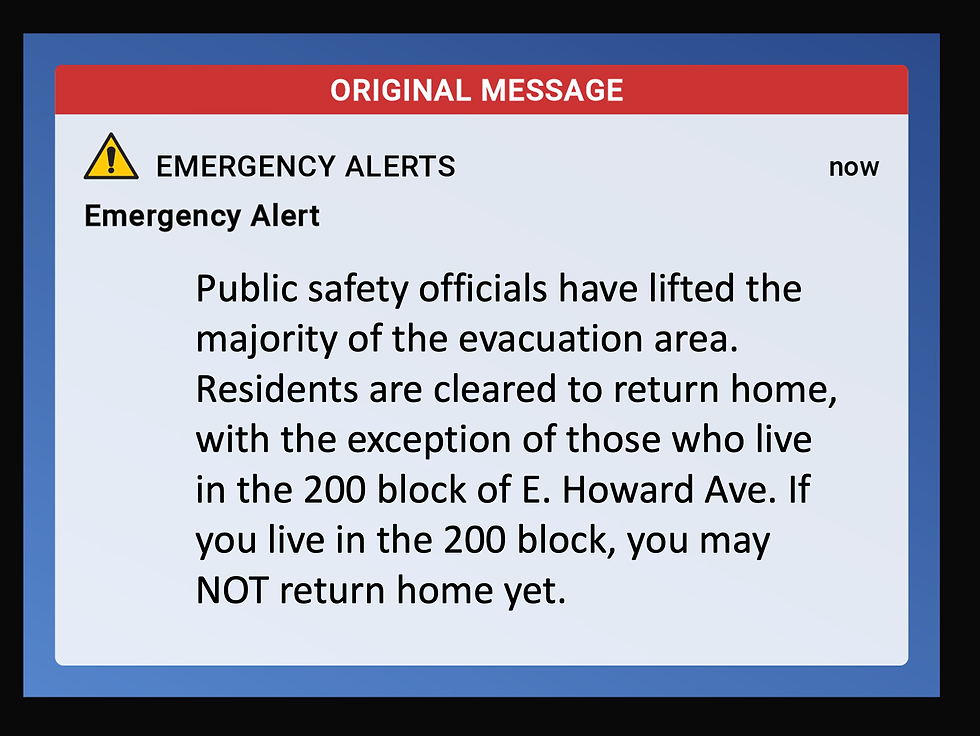
The follow up message went to a much broader population area covering much of the county. Unfortunately, it also did not include a message source or anything about the hazard for which the original message was issued.
As I said above, how to effectively communicate to people who have been evacuated via WEA is a real challenge. You can’t easily reach those who have left the evacuation area using that same WEA channel unless you significantly increase the boundaries of your alert area. And when this is done, you’re alerting a whole new population that will not be familiar with the initial alert including information about the hazard and the dangers associate with it.
According to news reports, the all clear message that was issued by WEA in Jackson Township was rather confusing and drove people to search for information about the original hazard to determine if they were, or had been previously, at risk of some unknown hazard.
While the boundary question is a problem without a good answer, there is a solution to the message content quandary. If every message that is issued is complete, even the all clear message, you will reduce a lot of confusion and frustration. We know that in this case the original message was pretty good; adding a link would have provided a direct connection to a cite for updates, including an all clear message.
In the all clear message, adding the name of the source, a description of the hazard and it’s impacts, and also providing greater detail about the original evacuation instructions would help people to quickly identify that they were not the recipients of the original message and they were not currently at risk.
According to those same news reports, the sending organization has determined that the problem with the all clear message was a lack of specificity about location and that "location information will be prioritized" in the future. In the case of this message, I don't believe this is the primary issue although greater location specificity would be an improvement.
There is no simple solution to determining the best means to reach people who have been evacuated. But I hope you can agree that including ALL of the relevant message contents can help to reduce some of the associated problems.
Feel free to share this post with others but be sure to give attribution to the author.
Also, if you want templates to help you write better all clear messages, be sure to check out the “Post-Alert Lexicon” available on The Warn Room resources page.


